 Scroll ↓
Transforming Nigeria's maritime registration system into a modern digital platform. Digitizing registration, regulatory approvals, inspections, payments and stakeholder collaboration across multiple government departments.
Scroll ↓Nigeria's Ship Registry plays a critical role in regulating vessel registration, ownership and compliance within the country's maritime ecosystem. Yet many processes remained fragmented, document heavy and dependent on manual coordination across several departments.
The goal was to design a modern digital platform that would simplify ship registration while improving transparency, operational efficiency and collaboration between internal teams and external stakeholders.
I led the end to end product design effort, partnering with stakeholders across the Registry of Ships, Finance, Legal, ICT and executive leadership to translate complex regulatory procedures into intuitive digital workflows.
The biggest challenge was not designing software. It was translating decades of government process into a digital product without losing regulatory integrity.
Each department had its own process, terminology and expectations, making alignment one of the most significant design challenges. The friction showed up everywhere.
As Lead Product Designer, I owned discovery through delivery, translating regulation into workflows and workflows into interfaces.
Rather than jumping into interface design, we spent time understanding how the registry actually operated. That work surfaced opportunities to simplify several operational processes before a single screen was drawn.
 Scroll ↓
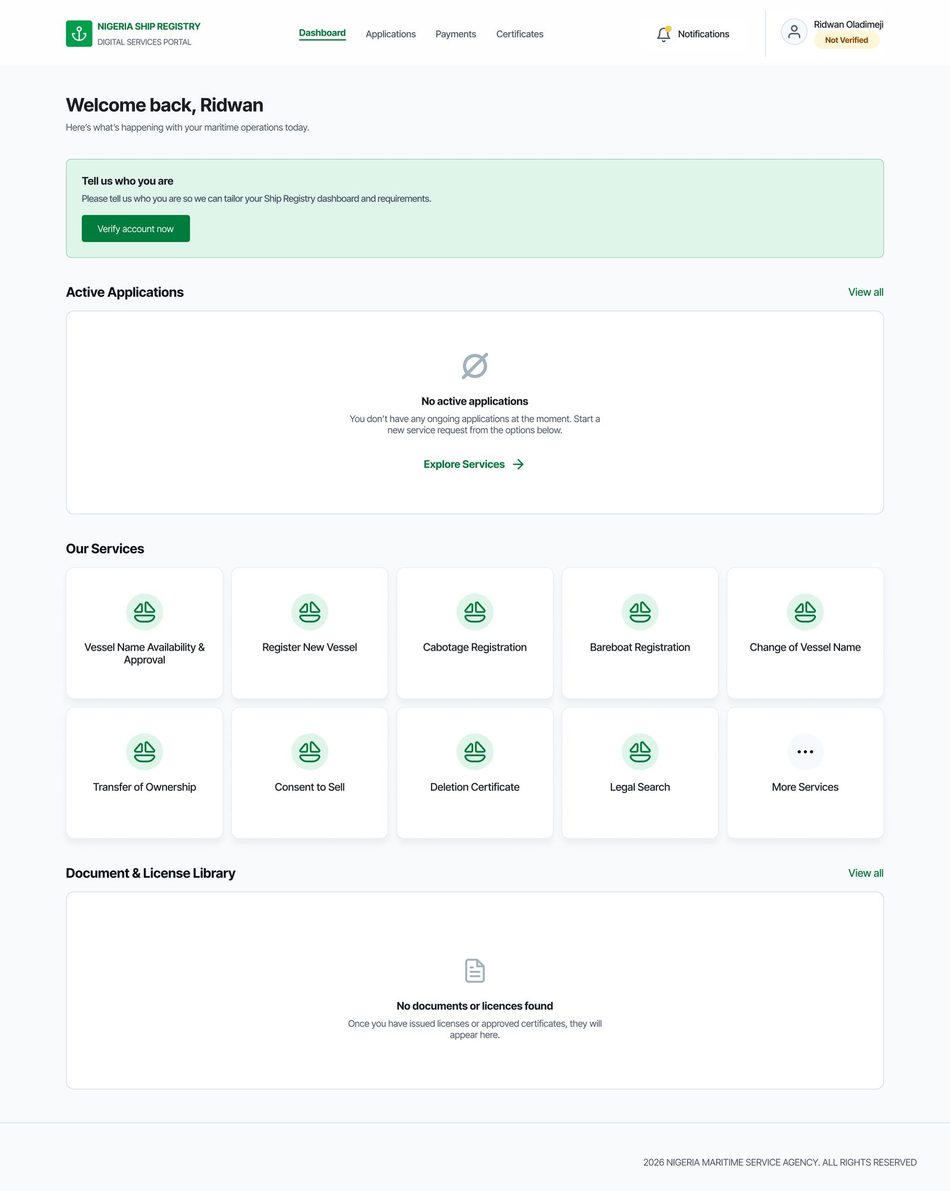
Unlike a consumer product, each user required different permissions, workflows, dashboards and approval capabilities.
Complex regulations should feel understandable.
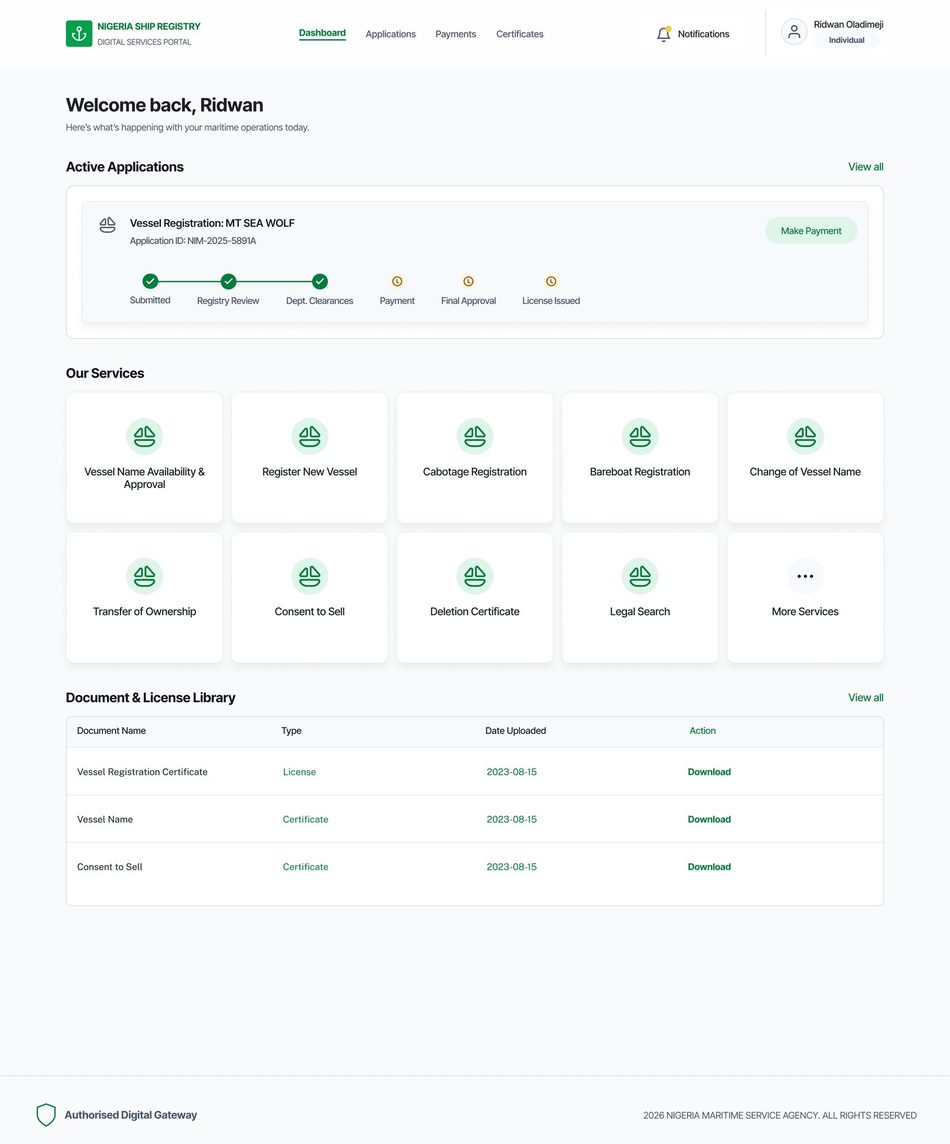
Applicants should always know where an application stands.
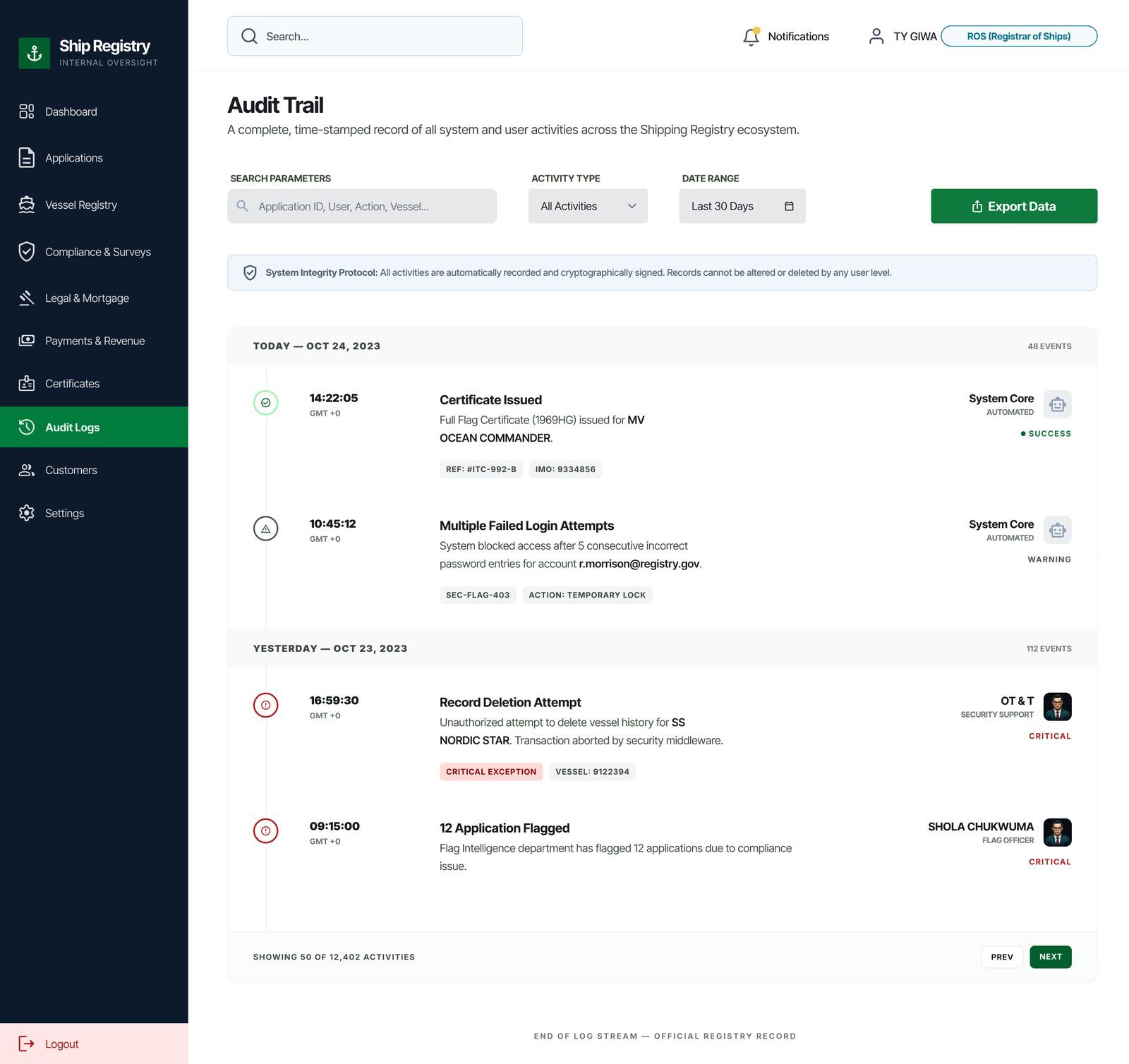
Every action should leave an audit trail.
Reduce unnecessary manual work.
Support future maritime services beyond ship registration.
The platform was designed around modular services so new maritime offerings could be added without re architecting the system.
Every stage carried status updates, notifications, audit logs and role based permissions.
 Scroll ↓
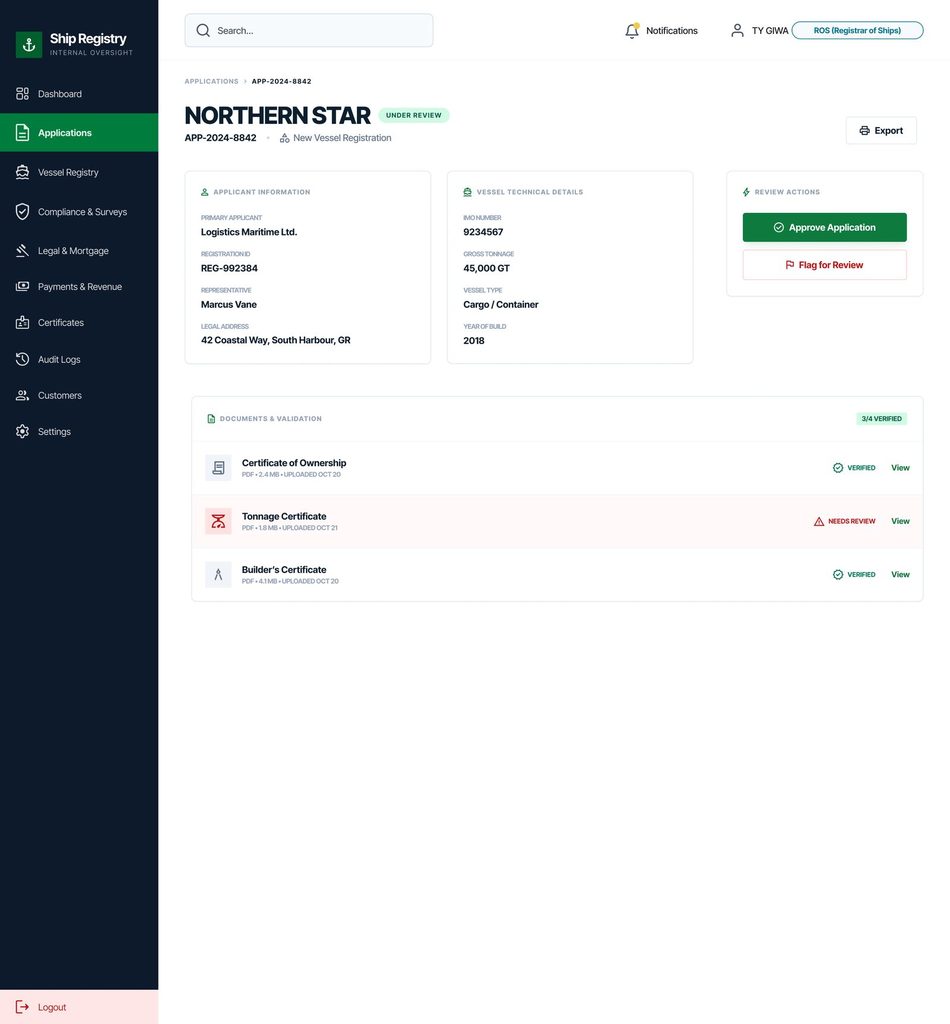
Instead of a generic admin dashboard, each department received information tailored to its responsibilities.
Executive leadership received operational KPIs, departmental health, turnaround times and overall registry performance at a glance.
Lengthy forms were grouped into manageable steps instead of overwhelming applicants all at once.
Every user saw only the tools relevant to their responsibilities.
Applicants could follow progress without repeatedly contacting the registry.
Reusable components kept dozens of workflows consistent while reducing implementation effort.
 Scroll ↓
Balancing user needs, regulatory compliance and technical feasibility was a constant part of the process.
Not part of the initial scope, but several opportunities emerged for a future phase.
While the platform was still progressing toward implementation, the redesign established a strong digital foundation for modernizing one of Nigeria's most important maritime regulatory systems.
Designing for government taught me that the hardest problems rarely involve interfaces. They involve people, processes, regulations and organizational alignment.
The success of enterprise software depends on understanding operational systems as deeply as user interfaces. This project reinforced my passion for solving large scale, systems level problems where thoughtful product design improves both customer experience and institutional efficiency.